
What is 3D MID Manufacturing Process? From Design to Assembly
3D MID (Mechatronic Integrated Device) is an innovative technology that enables electrical circuits to be formed directly on the surface of three-dimensional molded plastic parts, allowing electronic components to be mounted directly onto the structure.
However, many engineers and product developers may wonder:
“How is a 3D MID actually manufactured?”-One Shot Manufacturing Process-
In this article, we explain the complete 3D MID manufacturing process, covering each step from design and
molding to circuit formation, plating, component assembly, and final inspection.
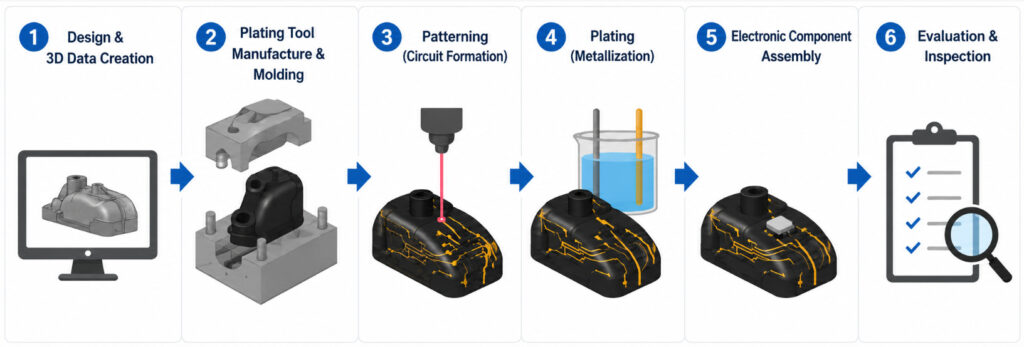
①Design & 3D CAD Modeling
The manufacturing process begins with the simultaneous design of the product geometry and electrical circuitry.
Because circuit traces must follow the three-dimensional shape of the molded part, detailed design using 3D CAD software is essential.
Electrical performance, component placement, manufacturability, and assembly requirements are carefully considered to optimize the overall product design.
②Mold Fabrication & Plastic Injection Molding
Based on the completed design data, a mold is manufactured and the plastic component is produced through injection molding.
Since the part has a complex three-dimensional structure, careful mold design is required to minimize defects such as uneven wall thickness, warpage, and sink marks.
Engineering plastics and thermosetting resins with excellent heat resistance and dimensional stability are commonly used as molding materials.
③Patterning (Circuit Formation)
A laser is used to irradiate the surface of the molded plastic part, activating the areas where electrical circuits will be formed.
This laser activation process creates a surface that allows subsequent metal plating to adhere selectively, enabling highly accurate and fine circuit patterns to be produced.
④Plating
After an initial electroless copper plating layer is formed, additional metal layers such as copper, nickel, and gold are deposited through electroplating.
By improving plating adhesion and electrical conductivity, highly reliable circuit patterns can be achieved.
⑤Electronic Component Assembly
Electronic components such as LEDs, sensors, and integrated circuits (ICs) are mounted onto the completed circuit patterns.
The assembly method is selected according to the product requirements and may include reflow soldering or conductive adhesives.
⑥Evaluation & Inspection
The finished 3D MID undergoes electrical continuity testing, visual inspection, and reliability testing, including heat resistance, humidity resistance, and vibration testing.
These evaluations verify the product’s performance and quality, ensuring stable operation even under demanding environmental conditions.
Key Points of the 3D MID Manufacturing Process
The manufacturing of a 3D MID involves several key processes, including design, injection molding, circuit formation, plating, electronic component assembly, and inspection.
By optimizing each of these processes, 3D MID technology enables high-density integration, product miniaturization, and outstanding reliability.
The quality and performance of a 3D MID depend not only on circuit formation but also on the successful integration of every manufacturing step, including material selection, molding technology, circuit formation technology, and plating technology.
For this reason, when applying 3D MID technology to a product, it is essential to consider the entire manufacturing process during the design stage.
If you would like to learn more about the basic structure and advantages of 3D MID, please also read our article:
🟦 What Is 3D MID? Structure, Benefits & Applications
3D MID Applications
For examples of how 3D MID technology is used across different industries, please visit the pages below.
At SENIN TECHNOLOGIES, we respond to two-shot manufacuring process as well as one-shot manufacturing process that we explained above and provide comprehensive support for 3D MID development, from material selection and manufacturing process evaluation to design, production, assembly, and sales.
If you are considering adopting 3D MID technology or are looking to achieve product miniaturization, higher functionality, or reduced part counts, please feel free to contact us. Our engineering team is ready to help you find the best solution for your application.